Multi‑Standard Compatibility: An Under‑Recognised Strength of Chinese Commercial Refrigerated Cabinet Manufacturing
The same production line: in the morning it makes glass-door refrigerated display cabinets for Europe; in the afternoon it switches to beverage display cabinets for the Middle East. The line and main tooling are not rebuilt, but the compressors, electrical components, control parameters, nameplates, test procedures, and packaging documents have all been changed to another version. A truly mature factory does not "change nothing"; it knows exactly what must be changed, what can be shared, and how to keep the switch-over within predictable cost and time.
This capability is not uncommon in China’s commercial refrigeration industrial cluster.
ICCOLD public materials show its products are sold in more than 100 countries and regions, covering CE, ETL, MEPS, SASO and other safety and energy-efficiency requirements. Hiron maintains a CNAS-accredited laboratory, multiple system and product certifications, and has participated in domestic commercial cabinet standard-setting. The number of certifications alone does not equal manufacturing capability, but long-term exposure to diverse markets does force companies to develop engineering and organisational methods that are difficult to replicate in the short term.
The deepest barrier in multi-standard compatibility is not how many countries’orders a company has fulfilled, but whether it can continue to deliver stably with manageable complexity as rules keep changing.
I. "Multi-Standard" Is Not Just a String of Certificate Names
When the industry talks about multi-standard compatibility, it often lists CE, ETL, RoHS, MEPS, SASO, and multinational customers’ factory-audit requirements side by side. In reality, these sit at different levels: some are market-access and compliance declarations, some are electrical safety and material restrictions, some are energy-efficiency and test methods, and others are customers’ own quality, sustainability, and supply-chain audits. Lumping all of these together as "certifications" obscures the real workload.
Take commercial refrigerated cabinets as an example: EU Regulation (EU) 2019/2024 specifically covers refrigerating appliances with a direct sales function, with provisions on scope, ecodesign, energy efficiency, and information disclosure. The US Department of Energy includes commercial refrigeration equipment - with or without doors, self-contained or remote - under 10 CFR Part 431 for testing, certification, and efficiency frameworks. Australia’s 2024 GEMS determination references ISO 23953-2:2023, defining product categories, M-package temperature classes, test-room climate classes, 24-hour energy consumption, and door-opening test conditions. A seemingly identical "vertical refrigerated display cabinet" may be placed in different classification boundaries in these three markets, using different test conditions and reporting logic.

Thus, the hardest part of multi-standard compatibility is not passing a single test, but accurately understanding which design variable a given regulatory difference ultimately affects. A change in temperature class may affect evaporator sizing, airflow, and control logic; a higher test-room ambient temperature may require larger condenser margin; different door-opening cycles alter anti-condensation heating and defrost strategies; and different energy-calculation boundaries affect lighting, fan, and heater control. Certificates are outcomes; the causal chain between design and verification is the real capability.
Brand-owner corporate standards are often more opaque and more binding than national standards. A beverage brand may require a cabinet to run continuously for 72 hours at 32°C and 85% relative humidity with no condensation - a test condition far more severe than most national efficiency boundaries. Brand owners do not publish these standards; they simply enforce them during supplier audits. Companies that make it onto approved-supplier lists have typically already absorbed these implicit requirements in advance.
II. "Hero-Style" Compatibility vs. "Platform-Based" Compatibility
Many factories appear highly flexible, able to accept orders from different countries, but in practice they rely on engineers working overtime, manual checking, and on-the-spot approvals. BOM versions are memorised, substitute materials are chosen by experience, and test conditions are set by on-site engineers. This is "hero-style" compatibility: the company can indeed produce the orders, but capability is concentrated in a few individuals, and each additional market adds hidden complexity.
By contrast, "platform-based" compatibility means the company proactively converges market differences into clear modules - voltage and frequency into an electrical package, anti-condensation strategies into a door module, energy-test conditions into a control-parameter library. Adding a new regional version requires replacing only a few modules and parameter files, rather than redesigning the appliance and re-validating all performance. The difference between the two types is not obvious when orders are few; but once products enter dozens of countries over many years, the cost gap becomes stark.
The truly valuable compatibility capability is to confine market differences to a limited number of modules on a relatively stable platform. Common shared parts in commercial refrigerated cabinets include the cabinet skeleton, foam structure, door platform, shelf system, and basic air duct; items that need to be switched by market include voltage and frequency, plugs and wiring harnesses, compressors and fans, controller programs, anti condensation heaters, lamps, electrical protection, refrigerant options, nameplate labels, and test software. A mature platform does not pursue universal part commonality; it clearly distinguishes what must be common, what can be optional, and what must be dedicated.

What outsiders see as a line that can produce orders for many countries is, inside the factory, actually reliant on product architecture: does a regional version change require only replacing an electrical package and parameter file, or does it force changes to sheet metal, foaming moulds, the refrigeration system, packaging, and the entire test suite? The former is platform-based flexibility; the latter is just putting out fires with engineers and planners.
Multi-standard compatibility can also divert resources from original development. Companies spend so much time meeting customers’ established requirements that they tend to direct their best engineering resources to project response rather than fundamental technology and next-generation platforms. But the problem is not "compatibility" itself; it is whether a company abstracts project experience into common technology. Without abstraction, experience only adds complexity; with abstraction, compatibility becomes an input to innovation.
III. "Organisational Memory" Is Not Only on the Production Line - It Is Also in Version Rules and Validation Boundaries
Long-term OEM work does build organisational memory, but if that memory exists only in veteran employees’ heads, it is fragile. A company that can reliably deliver across markets typically institutionalises experience in four places.
First, version rules. One appearance model may have dozens of regional versions; any substitution must be known to affect which certificates, which tests, and which inventory. Second, supplier data. Compressor, motor, controller, lamp, wiring, and material suppliers must provide not only product but also the certifications, performance data, and change records needed for different markets. Third, laboratory capability. Without repeatable temperature, energy, safety, and reliability verification, a company must rely on external testing and wait after every change. Fourth, traceability. When a market complaint arises, the company must be able to trace back to the specific batch, part version, program, and inspection record.
Hiron’s public information shows it has a CNAS-accredited laboratory and has participated in work on GB/T 21001 "Refrigerated display cabinets" and commercial cabinet energy efficiency. The value of such investment is not just in obtaining accreditation, but in shortening the chain from "identify a difference" to "locate the impact" to "complete verification." What is truly scarce in the industry is not one engineer knowing the difference between US and European requirements, but the company’s ability to reproduce that judgement reliably after personnel changes.
IV. Why Are Chinese Companies More Likely to Develop This Capability?
It would be inaccurate to describe multi-standard compatibility as uniquely Chinese. Europe, Japan, and the United States all have deep expertise in standards, R&D, and global manufacturing; some multinational companies have far more profound understanding of regulations and test methods than most Chinese firms. China’s advantage is more of a combinatorial one: under relatively large product variety, rapid order changes, and cost constraints, Chinese factories have long handled demand from multiple countries.
Over decades of OEM and export business, Chinese factories have simultaneously served European retailers, North American beverage brands, Middle Eastern distributors, Australian retail chains, and Southeast Asian local customers. Diverse orders constantly flow through the same supply chains, forcing compressor, motor, controller, glass-door, lighting, and sheet-metal suppliers to accumulate multi-version experience together. The value of the industrial cluster is not just that "any component can be sourced," but that the same supplier often already knows what documentation, what margin, and what support is required for different markets.
Commercial cabinets intensify this training. Unlike more standardised household products, commercial cabinets frequently need to be adapted to customer branding, load dimensions, store layouts, ambient temperature and humidity, door-opening frequency, and after-sales conditions. Order volumes may be large, but models and appearances are highly fragmented. Chinese companies have developed low switch-over costs in an environment where both scale and variety coexist - that is the industrial foundation of multi-standard capability.
V. The Same Cabinet Across Markets - Changes Are Often More Than Voltage and Plug
The difficulty of standard differences for commercial refrigerated cabinets lies in the tight coupling between product performance and usage scenarios. Europe emphasises ecodesign and energy information for direct-sales appliances; the US classification and efficiency requirements differentiate by doors, temperature zones, condensing method, and display area; Australia’s GEMS framework defines climate classes, temperature classes, door-opening cycles, and 24-hour energy consumption. Products that appear similar may be subjected to completely different thermal loads during testing.
For example, a glass-door beverage cabinet in hot-humid regions requires more attention to door condensation, condenser margin, and dust clogging; an open-multi-deck air-curtain cabinet’s air velocity, return-air openings, and load boundaries directly affect temperature and energy consumption; an ice-cream freezer’s lid-opening frequency, defrost method, and temperature recovery affect real-world user experience. Regulations provide only minimum boundaries; customers' internal standards often add requirements for temperature pull-down, drop tests, salt spray, door-life cycles, noise, packaging, and brand image - these implicit criteria are often harder to anticipate than regulations, and they separate the best from the rest.
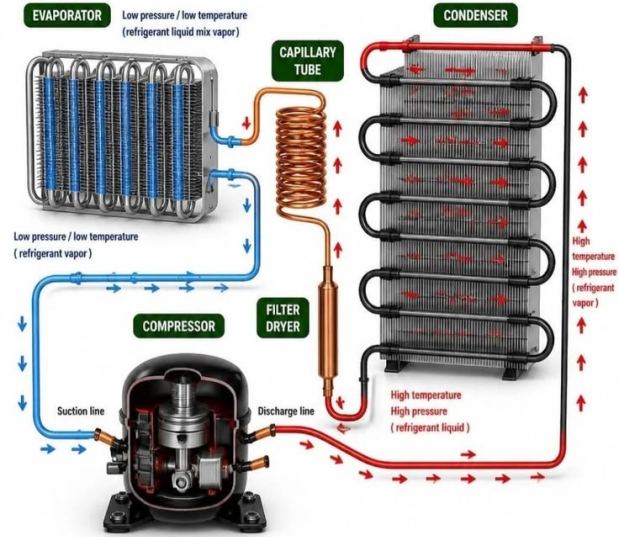
Thus, "switching to a country version" sometimes means not changing a plug and label, but re-balancing the entire thermodynamic system of the cabinet. Good companies keep the platform as stable as possible, adjusting only necessary modules; weaker ones may mask problems in mass production by upsizing compressors, adding heaters, or relaxing control parameters, ultimately paying with higher energy consumption, higher cost, or poorer reliability.
VI. From Reading Rules to Helping Define Them
Chinese refrigeration companies are increasingly participating in standard-setting. Hiron has contributed to work on refrigerated display cabinets and commercial cabinet energy efficiency. In 2025, Gree led the development of two international standards for refrigeration compressors, covering performance evaluation for positive-displacement and centrifugal types. The latter is not a complete-cabinet standard, but it signals that China’s refrigeration industry is moving from adopting and adapting international rules to participating in performance-evaluation methodology discussions.
But moving from compatibility to definition does not happen automatically by collecting more certificates or joining committees. Companies must first be able to explain why different countries’ test boundaries differ, which differences reflect real usage scenarios and which are merely historical classification conventions; they must also convert their own project data into repeatable measurement methods and industry consensus.
The difference between the Gree case and Hiron is this: Hiron participates in domestic standards - industry consensus building; Gree leads ISO international standards, involving direct technical negotiation with experts from multiple countries - test-condition choices, reference-temperature definitions, and energy-calculation methods each carry commercial interests. Gree succeeded partly by choosing "compressor performance evaluation" as a relatively neutral entry point, avoiding the regulatory turf of national energy-label regimes. That is a strategic choice: accumulate rule-making experience in a secondary battlefield, preparing for future entry into more core finished-product standards.
In other words, standards leadership is not "I can satisfy everyone's requirements"; it is "I can propose a clearer, more verifiable way to describe the problem." That requires deeper fundamental research and long-term field data. Compatibility lets a company read different rules; genuine originality comes from distilling common variables from behind those rules.
The multi-standard advantage of Chinese commercial refrigerated cabinet manufacturing cannot be reduced to having many certifications, a full supply chain, or skilled workers. It is a systemic capability: controlling variation with product platforms, supporting versions with supply-chain data, validating boundaries with laboratories, and maintaining long-term consistency with a change-management system.
This capability does not automatically lead to technological leadership; it can also be bogged down by SKU proliferation and project fire-fighting. Its true value boundary lies in whether the company can turn "every customer is different" into "although there are many differences, they can be explained and managed by a few modules."
The deepest barrier in multi-standard compatibility is not how many countries' orders a company has fulfilled, but whether it can continue to deliver stably with manageable complexity as rules keep changing.
Sources
[1] EU Regulation (EU) 2019/2024: Ecodesign requirements for refrigeration equipment with direct sales function: https://eur-lex.europa.eu/legal-content/EN/TXT/?uri=uriserv%3AOJ.L_.2019.315.01.0313.01.ENG
[2] US Department of Energy: Commercial Refrigeration Equipment Regulation, Testing and Certification Framework: https://www.energy.gov/cmei/buildings/commercial-refrigeration-equipment
[3] Australian Federal Regulation: Greenhouse and Energy Minimum Standards (Refrigerated Cabinets) Determination 2024: https://www.legislation.gov.au/F2024L01263/latest/text
[4] Hai Rong Cold Chain: System Certification, CNAS Laboratory and Product Certification: https://www.chinahiron.com/cn/channels/2.html
[5] Haier Cold Chain participates in the work on energy efficiency standards related to refrigeration display cases and commercial freezers: https://www.chinahiron.com/cn/contents/21/483.html
[6] ICCOLD Xike Cold Chain: Overseas Markets, Manufacturing Centers and Requirements of CE, ETL, MEPS, SASO, etc.: https://www.iccold.net/cn/NewsDetail/2366605.html
[7] Gree Electric Appliances: Two International Standards for Refrigeration Compressors to be Released in 2025: https://wap.gree.com/Article/view/bae29fe0e9e64168b7ef8d9d4a1ba7da


Comments