Global Industry Over Four Centuries – From the Great Divergence to Rebalancing
- Jul 13
- 8 min read
Over the past four centuries, global manufacturing dominance has shifted repeatedly—from Britain to the United States, diverging to Japan and Germany, and now concentrating in China. No shift was incidental. Each was the product of three interlocking forces: technological paradigm shifts (steam → electricity → electronics → AI), institutional and policy choices (patent laws, customs unions, industrial policies, reform and opening-up), and war and geopolitical shocks (Napoleonic Wars, World Wars, Cold War, US-China trade tensions). These forces are nested, not separate—new technologies demand new institutions to unlock their full potential; new institutions are often forged in the crucible of war and geopolitical upheaval; and geopolitical change, in turn, accelerates or impedes the spread of technology and institutions.
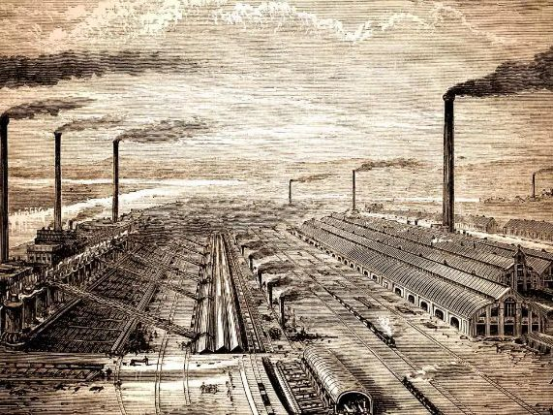
This chapter traces the four critical industrial-center shifts over four centuries, using the evolution of refrigeration technology as a tangible yardstick—from natural ice to ammonia compression, from Freon to natural refrigerants—so that each paradigm shift gains a perceptible, concrete measure. (The accelerating cycle of technological paradigms is an insight we will return to at the conclusion.)
Data note: Contemporary figures (20th century onward) use "manufacturing value-added as a share of global GDP." Historical data (19th century and earlier) are based on economic historians' estimates (e.g., Bairoch), as noted in the text.
Shift One: From Workshop to Machine Production (1760–1870) – Britain's Dominance and the "Great Divergence"
The spinning jenny appeared in 1765; Watt's improved steam engine began spreading in 1785. Machine production started replacing manual labor. For the first time in human history, production was no longer constrained by the physical limits of human muscle. By 1860, according to economic historian Paul Bairoch's estimates, Britain accounted for roughly 20% of global manufacturing output, producing about two-thirds of the world's coal and over 70% of its steel.
But why did the Industrial Revolution begin in Britain, rather than in China's Yangtze Delta, where living standards in the eighteenth century were broadly comparable to England's? Economic historian Kenneth Pomeranz, in The Great Divergence, points to three critical differences:
First, coal's geographic advantage. Britain's coalfields were close to the surface and navigable waterways, making transport astonishingly cheap. Output soared from 2.5 million tons in 1700 to 64.7 million in 1854. Coal was not just fuel for steam engines—it freed Britain from its dependence on timber, a bottleneck that constrained both China's Yangtze Delta and continental Europe.
Second, institutional preparation. The 1624 Statute of Monopolies gave inventors legal protection for exclusive returns; enclosure laws freed up labor; overseas colonies created boundless demand for cotton textiles.
Third, the commercialization of science. The Royal Society (founded in 1660) integrated science with industry a full generation earlier than in continental Europe.
The refrigeration yardstick: What was life like without refrigeration? Before artificial cooling, food preservation relied on natural ice—cut from rivers and lakes in winter, stored in ice houses for summer use. Meat processing could only happen in winter; brewing was temperature-dependent; long-distance food trade was nearly impossible. The natural ice trade was humanity's earliest "cold chain"—but its bottlenecks (transit loss, hygiene risks, seasonality) exposed the productivity ceiling of pre-industrial society.

The exponential growth of British coal output provided the power base that made mechanical refrigeration possible just over a decade later. The ammonia-compression refrigeration machine (1876) was not an accident—just as the steam engine was not purely Watt's genius, but the inevitable product of Britain's industrial energy reaching a tipping point. This is crucial to understand: refrigeration technology is not a side story independent of industrial history. It is a capability that naturally emerges once industrial energy reaches a certain scale.
But Britain's success also sowed the seeds of its decline. The overexpansion of the coal industry created path dependency—Britain had about 200,000 coal miners in 1850, reaching 1.2 million by 1914. When the oil and internal combustion era arrived, this vast coal system became an anchor around its neck.
Shift Two: From Britain to the United States (1870–1945) – The Rise of Mass Production
In 1860, US industrial output was only about 6% of the world total—still an agricultural nation. By 1900, that share had jumped to roughly 30%. In four decades, the United States completed the most dramatic leap in industrial history.
Three core drivers:
The immigration torrent. Between 1860 and 1900, over 14 million immigrants poured in, many of them skilled craftsmen and engineers from Germany and Britain. By 1910, the US workforce reached 37.5 million—3.4 times its 1860 level.
The railroad network. The transcontinental railroad was completed in 1869; by 1900, the US had 190,000 miles of track—more than all of Western Europe combined. Railroads unified the national market and supercharged steel, coal, and locomotive production.
The assembly line. Ford slashed automobile assembly time from 12 hours to 93 minutes in 1913—not a technological invention, but an organizational revolution. America rewrote the core logic of industrialization from "fine craftsmanship" to "standardization, scale, and replicability."
The US surpassed Britain in industrial output in 1894. By 1913, US industrial production equaled that of Britain, Germany, Japan, and France combined. By 1950, US manufacturing value-added accounted for roughly 40% of the global total.
The refrigeration yardstick: From industrial tool to household infrastructure. The ammonia-compression refrigeration machine (1876) served industrial cooling—meatpacking plants, breweries, and distant-water fisheries broke free from seasonal constraints for the first time. Refrigeration proved that humanity could create "winter" on demand.
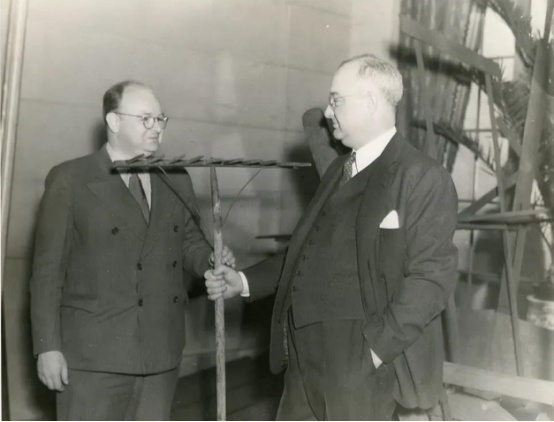
Freon's invention in 1928 made refrigeration equipment smaller and safer. Household refrigerators became a standard fixture in American homes in the 1950s; air conditioning redefined the livability of the American South, catalyzing the urban expansion of the Sun Belt. Refrigeration evolved from "factory equipment" to "household infrastructure."
The logic of this transformation is identical to America's industrial rise: standardization, scale, and replicability—from the Model T to the home refrigerator, the same industrial paradigm applied to different products. Americans didn't invent refrigeration (the ammonia system was German, from Carl von Linde), but they turned it into an affordable product for every household. That was America's signature strength: taking a technology from the lab to the assembly line as a standardized consumer good.
Shift Three: From the US to Japan and Germany (1945–1990) – Competition on Two Fronts: "Lean" vs. "Precision"
After WWII, American manufacturing looked unassailable. But challengers emerged from two different directions.
Japan's path: Lean. Toyota's just-in-time, automation, and kanban systems—not technological inventions, but management revolutions. In 1980, Japan's auto production surpassed America's for the first time. US auto workers produced 20 parts per hour; Japanese workers produced over 50. According to World Semiconductor Trade Statistics (WSTS), Japan's global semiconductor share exceeded 50% in the 1980s, reaching as high as 90% in DRAM.
What is lean production at its core? It defines "waste" as any activity that creates no value—then systematically eliminates it. This methodology applies to any manufacturing context—including precision compressor machining.
Germany's path: Precision. German unification came late (1871), and its domestic market was too small to support mass production at scale. German firms had to be globally oriented from the start—and in global markets, the only way to compete was to be better, more refined, more specialized than everyone else. The dual-system vocational training program supplied a steady stream of highly skilled technicians. "Hidden champions" captured global leadership in niche segments. A company making industrial valves might have annual revenue of only a few hundred million euros—but command over 70% of the global market.
Germany's model is essentially "not the biggest, but the deepest."

The refrigeration yardstick: The cross-industry migration of precision manufacturing. Japan's quality-control systems, developed in semiconductors, were seamlessly transferred to compressor manufacturing. Hitachi, Panasonic, and Mitsubishi Electric compressors—their valve-plate machining tolerances, rotor balance control, and sealing technologies—share the same industrial DNA as semiconductor manufacturing: precision machining, cleanroom discipline, zero-defect quality control. Lean production, as a methodology, is naturally suited to any manufacturing environment that demands "zero defects."
Germany likewise embodied its "focus" DNA in refrigeration. Bitzer, GEA, Kelvion—not household names, but roughly 70% of the world's supermarket cold chains and about 60% of industrial cooling systems depend on their components. Their product logic: not chasing the largest market share, but making the competition unable to catch up in their chosen niches—screw compressors, air coolers, heat exchangers.
What Japan and Germany shared: they didn't challenge the US on "scale"—they redefined the competitive dimension on "depth." Lean and precision are two different answers to the same question: "I can't beat you at sheer size, but I can outdo you on quality."
Shift Four: From Europe and America to China (1978–Present) – Ambition Beyond Scale
Reform and opening-up in 1978, WTO accession in 2001, surpassing the US in manufacturing value-added in 2010—China accomplished in 32 years what took the US over a century. In 2024, China's industrial value-added reached 40.5 trillion yuan, accounting for roughly 30% of global manufacturing.
What is the essence of China's industrial rise? Not a single-sector breakthrough, but the systematic construction of a whole-industry-chain ecosystem. Industrial clusters in the Yangtze and Pearl River Deltas achieve local sourcing rates above 60%, compressing delivery lead times from 45 days to 20. In global supply chain decision-making, that's a qualitative difference: when a delivery window shrinks from "six weeks" to "three weeks," global buyers' calculations are fundamentally rewritten.
But comparing China with Japan reveals deeper contrasts.

During Japan's catch-up phase in the 1960s–80s, it also achieved annual industrial growth above 10%. But Japan was catching up in an already mature global market—it had to "squeeze" market share out of the existing US and European industrial landscape. When China joined the WTO, globalization was in an expansionary phase, and global supply chains were undergoing their first true "flattening." China hit that window.
Yet China also faces the risks Japan once faced—and perhaps sooner.
After its bubble burst in the 1990s, Japan slipped into the "lost three decades," with near-zero GDP growth, and its semiconductor end-product market was overtaken by Korea and China. It retreated from "challenger" to "upstream gatekeeper"—Shin-Etsu Chemical's silicon wafers, Murata's ceramic capacitors, Fanuc's robotics remain irreplaceable nodes in the global supply chain.
China's current triple pressures (core-component bottlenecks, demographic decline, and cutthroat competition) closely resemble Japan's in the late 1980s. Japan at that time also had the world's largest manufacturing base, leading semiconductor capacity, and the most efficient supply chains. But Japan chose to stick with the IDM model, reject the Fabless-Foundry transition, and missed both the PC and internet windows.
The difference: Japan was forced to retreat upstream; China is actively vying for upstream control. The 2025 release of two ISO refrigeration compressor standards led by China (see Part One) signals that China's ambition is not merely to "hold onto scale," but to "export standards." That goes further than Japan ever did.
The refrigeration yardstick: From "none" to "largest" to "defining." In 1978, China's refrigeration equipment sector was almost nonexistent. By 2000, industry output hit 180 billion yuan—solving "having vs. not having." By 2017, it exceeded 650 billion yuan—solving "big vs. small." In 2025, ISO 18501/18483 were released—beginning to answer "who calls the shots."
This trajectory maps clearly onto the core logic of Shift Four: a latecomer nation's catch-up is not a linear retracing of its predecessors' path, but an attempt to leapfrog at every stage—from import to absorption, from absorption to definition. Refrigeration, as a concrete industry, has fully validated this path.
Conclusion: Paradigm Cycles Are Accelerating
Looking back at the four shifts, a clear pattern emerges:
Shift One (Britain) took roughly 80 years (steam era).Shift Two (United States) took roughly 60 years (electric era).Shift Three (Japan/Germany) took roughly 40 years (electronics era).Shift Four (China) took roughly 32 years (globalization era).
Technological paradigm cycles are shortening.
That means the window of scale leadership is also shrinking. Britain went from peak to decline in about 50 years; the US took about 70—but those were against paradigm cycles of 80 and 60 years. Today, China's manufacturing scale is number one globally, but the AI-era paradigm window may be only 20 years. If it fails to seize the initiative in the next generation of technological paradigms—AI-driven manufacturing, solid-state cooling, carbon-neutral processes—scale itself could become a liability rather than an asset.
For the refrigeration industry, this means one cannot rely on any single technological path for too long. Magnetocaloric, thermoacoustic, solid-state cooling—technologies still in the lab today could become commercial realities within a decade. China's refrigeration industry has just secured ISO standard-setting authority, but standards themselves have life cycles. The next round of standard-setting will not be about "who defines today's rules," but "who defines the next generation's rules."

China's refrigeration sector has gone from nothing to something over 40 years. But history shows repeatedly: there are no eternal hegemons, only the capacity for continuous renewal. If at this paradigm window we choose to "hold ground"—defending existing scale, existing standards, existing markets—then when the next shift comes, the script of being overtaken will repeat.
Seeing this pattern clearly is the only way to stay ahead in the next transition.


Comments