Commercial Display Refrigerator & Freezer LED Lighting Guide: CCT, CRI and Food Types
Which LED light is best for a commercial display refrigerator or freezer?
For mixed beverages, dairy and packaged chilled foods, 3500–4000K neutral-white LEDs are a practical starting point. For premium fresh food, consider CRI Ra ≥90; for general packaged merchandise, Ra ≥80 may be sufficient.
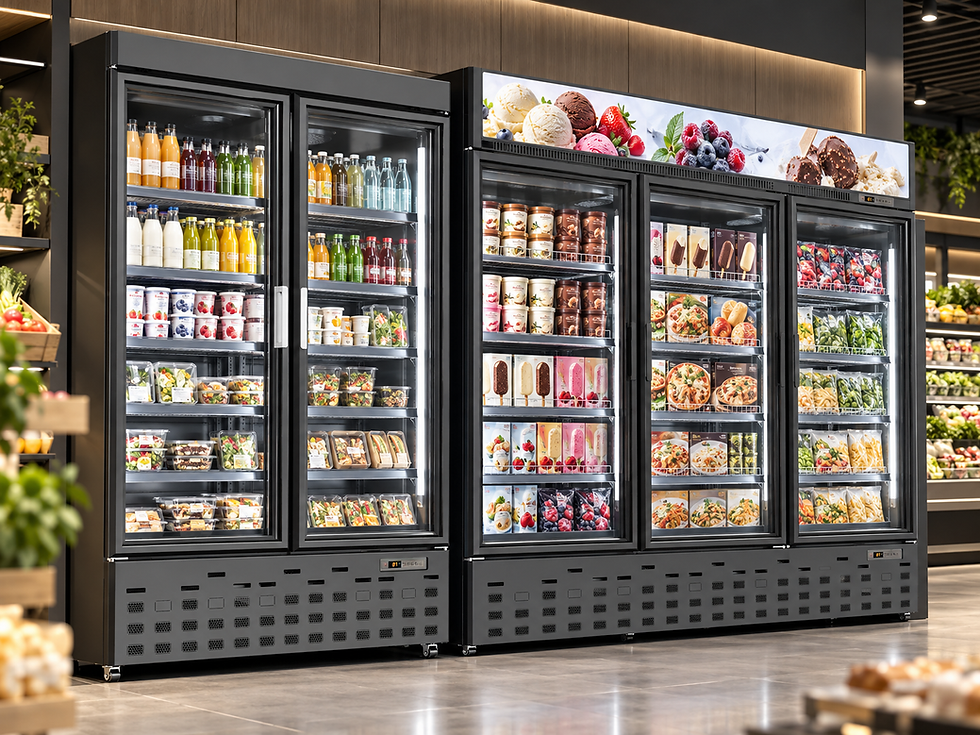
Seafood often benefits from 4000–5000K, while refrigerated cakes and some meat displays are commonly assessed around 3000–3500K. No single setting suits every product, glass door and shelf configuration.
For overseas retail buyers, refrigeration OEM/ODM specifiers and beverage brands, lighting is part of merchandising performance and equipment engineering.
This guide from Truecooltech covers 51 chilled and frozen merchandising categories, including meat, seafood, dairy, beverages, fresh produce, ready meals, desserts, ice cream and specialty products.
The recommendations apply to glass-door refrigerators, open multideck chillers, island displays, upright freezers, chest freezers and specialty food showcases.
Important: Suggested Kelvin ranges and CRI levels in this guide are design starting points, not legally required values or proof of food safety. Always confirm actual food holding temperatures and applicable market requirements.
1. Why Display-Case Lighting Needs Its Own Specification
Lighting inside a refrigerated display case must help shoppers identify products through glass, make labels readable at multiple shelf levels and preserve believable food colors.
It also operates near cold surfaces, moisture, condensation and sometimes frost.
A high-output LED can still create a poor display if it produces harsh reflections or leaves the bottom shelves dark.
Better Product Visibility
Properly positioned LED lighting helps illuminate merchandise across multiple shelves and display areas.
This is particularly important in glass-door refrigerators, where customers often make purchasing decisions without opening the doors.
Natural Food Color Presentation
Fresh meat, seafood, vegetables, dairy products and desserts have different color-rendering requirements.
The goal should be to reveal natural product colors rather than artificially intensifying reds, greens or other hues.
Improved Brand Presentation
For an FMCG-branded cooler, the lighting should complement physical products, packaging graphics and brand colors.
Uniform LED lighting can improve label visibility and help create a consistent visual presentation across multiple refrigerated cabinets.
Refrigeration Performance
Lighting is also part of the refrigerator's electrical and thermal system.
The LED installation must not compromise door operation, airflow, refrigeration performance, cleanability or electrical safety.
2. CCT vs. CRI vs. R9: What Should Buyers Specify?

2.1 Correlated Color Temperature (CCT)
Correlated Color Temperature describes whether white light appears warmer or cooler. It is measured in Kelvin (K).
Lower CCT values produce warmer-looking light, while higher values produce cooler-looking light.
CCT does not directly measure color accuracy.
Recommended Starting Color Temperatures for Food Displays
2700–3000K — Warm White
Typical applications: Selected bakery and specialty dessert presentations.
3000–3500K — Warm-Neutral White
Typical applications: Refrigerated cakes, pastries, selected meat and charcuterie displays.
3500–4000K — Neutral White
Typical applications: Mixed packaged chilled foods, dairy, beverages, ready meals and many frozen products.
4000–4500K — Cool-Neutral White
Typical applications: Vegetables, selected fresh produce, frozen vegetables and fish displays.
4500–5000K — Cool White
Typical applications: Selected fresh-fish and edible-ice merchandising concepts.
These are practical lighting design starting points rather than universal industry requirements.
2.2 Color Rendering Index (CRI)
The Color Rendering Index, commonly expressed as Ra, describes how closely a light source reproduces colors compared with a reference illuminant.
For commercial refrigeration applications:
CRI Ra ≥80: A useful baseline for many packaged beverages, frozen foods and general retail merchandise.
CRI Ra ≥90: Worth evaluating for fresh meat, seafood, colorful produce, premium desserts and other color-sensitive products.
Higher CRI does not automatically guarantee the best merchandising result. Lighting distribution, brightness, glare, packaging and the overall spectrum must also be considered.
2.3 R9 and TM-30
R9 describes an additional aspect of saturated-red color rendering.
It is particularly relevant to fresh red meat and other products containing strong red tones.
For premium projects, IES TM-30 provides more detailed information about color fidelity and changes in color saturation.
Project-specific targets such as R9 ≥70 can be considered where justified by product testing, but they are not universal food-display requirements.
Two LEDs with the same color temperature may have different spectra and render food colors differently.
Therefore, a professional lighting specification should consider CCT, CRI, R9 where relevant, light distribution and actual product testing.
3. Chilled Food Lighting Selection Matrix: 28 Categories

Commercial chilled cabinets include glass-door display refrigerators, open-front multideck refrigerators, semi-vertical display cases, refrigerated island cabinets, meat and seafood showcases, refrigerated bakery and dessert displays, grab-and-go food merchandisers, and branded beverage coolers.
The following matrix provides practical starting recommendations for 28 refrigerated merchandising categories.
These recommendations only apply to foods actually intended for refrigerated sale.
Not all products within a category require refrigeration, and different products may require different storage conditions.
Chilled Food LED Lighting Recommendations
1. Fresh Red Meat
Representative products: Beef steaks, pork, lamb.Recommended trial CCT: 3000–3500K.Color-rendering target: CRI Ra ≥90; assess R9.
2. Fresh Poultry
Representative products: Chicken, duck, turkey.Recommended trial CCT: 3500–4000K.Color-rendering target: CRI Ra ≥90.
3. Minced Meat and Offal
Representative products: Minced meat, liver, heart, tongue.Recommended trial CCT: 3000–4000K.Color-rendering target: CRI Ra ≥90; assess R9.
4. Chilled Cooked Meats
Representative products: Cold cuts, cooked beef, chilled roast chicken.Recommended trial CCT: 3000–3500K.Color-rendering target: CRI Ra ≥90; assess R9.
5. Cured and Smoked Meats
Representative products: Ham, bacon, sausages, cured meats.Recommended trial CCT: 3000–3500K.Color-rendering target: CRI Ra ≥90; assess R9.
6. Fresh Fish
Representative products: Whole fish, fillets, raw fish.Recommended trial CCT: 4000–5000K.Color-rendering target: CRI Ra ≥90.
7. Shellfish and Crustaceans
Representative products: Shrimp, crab, shellfish, chilled seafood.Recommended trial CCT: 3500–4500K.Color-rendering target: CRI Ra ≥90.
8. Ready-to-Eat Seafood
Representative products: Smoked salmon, fish roe, cooked prawns.Recommended trial CCT: 3500–4000K.Color-rendering target: CRI Ra ≥90.
9. Milk and Yoghurt
Representative products: Fresh milk, yoghurt, fermented milk, dairy drinks.Recommended trial CCT: 3500–4000K.Color-rendering target: CRI Ra ≥80; ≥90 preferred.
10. Cheese, Butter and Cream
Representative products: Cheese, butter, fresh cream, soft cheese.Recommended trial CCT: 3000–4000K.Color-rendering target: CRI Ra ≥90.
11. Refrigerated Plant-Based Drinks
Representative products: Chilled oat milk, soy milk, plant-based yoghurt.Recommended trial CCT: 3500–4000K.Color-rendering target: CRI Ra ≥80; ≥90 preferred.
12. Packaged Beverages
Representative products: Bottled water, soda, energy drinks, iced tea.Recommended trial CCT: 3500–4500K.Color-rendering target: CRI Ra ≥80; ≥90 preferred.
13. Juice and Ready-to-Drink Coffee
Representative products: Cold-pressed juice, smoothies, RTD coffee.Recommended trial CCT: 3500–4000K.Color-rendering target: CRI Ra ≥90 preferred.
14. Beer and Wine
Representative products: Beer, white wine, sparkling wine.Recommended trial CCT: 3000–4000K.Color-rendering target: CRI Ra ≥80; ≥90 preferred.
15. Leafy Vegetables and Herbs
Representative products: Lettuce, spinach, cilantro, basil.Recommended trial CCT: 4000–4500K.Color-rendering target: CRI Ra ≥90.
16. Colorful Fruit and Vegetables
Representative products: Tomatoes, peppers, berries, grapes.Recommended trial CCT: 3500–4500K.Color-rendering target: CRI Ra ≥90.
17. Mushrooms and Prepared Vegetables
Representative products: Mushrooms, trimmed vegetables, chilled root vegetables.Recommended trial CCT: 3500–4000K.Color-rendering target: CRI Ra ≥90 preferred.
18. Fresh-Cut Fruit and Salads
Representative products: Fruit cups, cut melon, ready-to-eat salads.Recommended trial CCT: 3500–4000K.Color-rendering target: CRI Ra ≥90.
19. Sushi and Grab-and-Go Meals
Representative products: Sushi, rice balls, sandwiches, chilled platters.Recommended trial CCT: 3500–4000K.Color-rendering target: CRI Ra ≥90 preferred.
20. Chilled Meal Trays and Cooked Dishes
Representative products: Cold meals, prepared salads, pasta, meal trays.Recommended trial CCT: 3000–4000K.Color-rendering target: CRI Ra ≥90 preferred.
21. Fresh Noodles and Dough
Representative products: Fresh pasta, noodle sheets, pizza dough.Recommended trial CCT: 3500–4000K.Color-rendering target: CRI Ra ≥80; ≥90 preferred.
22. Tofu and Plant Proteins
Representative products: Tofu, bean curd, plant-based meat.Recommended trial CCT: 3500–4000K.Color-rendering target: CRI Ra ≥90 preferred.
23. Fermented and Pickled Foods
Representative products: Kimchi, sauerkraut, chilled pickled vegetables.Recommended trial CCT: 3500–4000K.Color-rendering target: CRI Ra ≥80; ≥90 preferred.
24. Refrigerated Sauces and Dips
Representative products: Fresh salsa, hummus, sauces, dips.Recommended trial CCT: 3500–4000K.Color-rendering target: CRI Ra ≥90 preferred.
25. Eggs and Liquid Egg
Representative products: Refrigerated shell eggs, liquid egg, egg products.Recommended trial CCT: 3500–4000K.Color-rendering target: CRI Ra ≥80; ≥90 preferred.
26. Refrigerated Cakes and Pastries
Representative products: Cream cakes, éclairs, cheesecake.Recommended trial CCT: 3000–3500K.Color-rendering target: CRI Ra ≥90.
27. Chilled Desserts
Representative products: Mousse, pudding, tiramisu, jelly cups.Recommended trial CCT: 3000–4000K.Color-rendering target: CRI Ra ≥90.
28. Refrigerated Pet Food
Representative products: Fresh pet meals and raw pet food.Recommended trial CCT: 3500–4000K.Color-rendering target: CRI Ra ≥80; ≥90 preferred.
The pet-food category is a separate specialty application and should be displayed apart from human food products.
3.1 Fresh Meat and Poultry Displays
Fresh meat lighting requires particular attention to natural color rendering.
For red meat, warm-neutral white lighting around 3000–3500K is a practical trial range.
High color fidelity and appropriate saturated-red rendering can help preserve the natural appearance of beef, pork and lamb.
For poultry, neutral-white lighting around 3500–4000K may provide a cleaner appearance without excessive yellow or red coloration.
Recommended design considerations:
Evaluate CRI Ra ≥90 and R9 where relevant.
Use diffused lighting to minimize harsh reflections.
Avoid artificially intensified red illumination.
Prevent localized heating of the display area.
Confirm the product's required storage temperature.
3.2 Fresh Fish and Seafood
Fresh fish and seafood displays often benefit from neutral to cooler-white illumination.
For fresh fish, 4000–5000K can be used as an initial trial range.
For shrimp, shellfish and smoked seafood, 3500–4500K or more neutral lighting may be appropriate.
Seafood display cabinets can operate in particularly humid environments.
LED systems must therefore be evaluated for moisture exposure, corrosion, cleaning requirements and electrical safety.
Specialized seafood cabinets may also require storage temperatures close to melting ice.
3.3 Dairy Products and Packaged Beverages
For dairy products, bottled drinks and mixed convenience-store merchandise, 3500–4000K neutral-white lighting is often a practical starting point.
Glass-door beverage coolers should provide:
Even illumination from upper to lower shelves.
Clear visibility of product labels and logos.
Natural color rendering of packaging graphics.
Controlled reflections on glass doors.
Suitable lighting across the entire cabinet depth.
Vertical LED strips and diffused lighting profiles are common design approaches.
For branded beverage merchandisers, the LED lighting should complement the cabinet's exterior design and brand presentation.
3.4 Fresh Produce and Vegetables
Fresh produce includes leafy greens, herbs, tomatoes, peppers, berries, mushrooms and prepared vegetables.
A 3500–4500K trial range can accommodate many different produce categories.
Leafy vegetables and herbs are often evaluated around 4000–4500K.
For brightly colored fruits and vegetables, high color fidelity is important for maintaining natural red, yellow and green tones.
Uniform illumination is generally preferable to narrow, high-intensity lighting.
Product-specific temperature and humidity requirements remain essential.
3.5 Refrigerated Bakery and Dessert Displays
Refrigerated cakes, pastries, cream desserts and specialty confectionery often benefit from warm-neutral white lighting.
A trial range of 3000–3500K can enhance the appearance of many cakes and pastries.
However, products containing white cream, colorful fruit, mousse or pale decorations should be tested to avoid unnatural yellow tones.
For premium refrigerated dessert showcases, diffused lighting and controlled reflections are often more important than maximum brightness.
3.6 Ready Meals, Sushi and Grab-and-Go Foods
Sandwiches, sushi, rice balls, refrigerated meal trays and prepared salads often contain multiple ingredients and packaging materials.
Neutral-white lighting around 3500–4000K offers a useful starting point.
Uniform shelf illumination should help customers identify products and read labels.
Storage requirements should follow the most temperature-sensitive ingredients and applicable food safety rules.
4. Frozen Food Lighting Selection Matrix: 23 Categories

Commercial frozen-food displays include vertical glass-door freezers, horizontal chest freezers, sliding glass lid freezers, island freezers, ice cream dipping cabinets and frozen-food supermarket displays.
Many packaged frozen foods are commonly stored around −18°C or colder.
However, specialized ice cream service cabinets, gelato dipping displays and other frozen-product applications may have different engineered operating conditions.
The lighting recommendations below do not determine food-safe storage temperatures.
Frozen Food LED Lighting Recommendations
1. Ice Cream and Gelato
Representative products: Bulk ice cream, scooping gelato.Recommended trial CCT: 3000–4000K.Color-rendering target: CRI Ra ≥90 preferred.
2. Ice Lollies and Sorbet
Representative products: Ice pops, bars, packaged sorbet.Recommended trial CCT: 3500–4500K.Color-rendering target: CRI Ra ≥80; ≥90 preferred.
3. Frozen Red Meat
Representative products: Frozen beef, lamb, pork, steaks and rolls.Recommended trial CCT: 3500–4000K.Color-rendering target: CRI Ra ≥90; assess R9.
4. Frozen Poultry and Offal
Representative products: Frozen chicken, duck, wings, minced poultry.Recommended trial CCT: 3500–4000K.Color-rendering target: CRI Ra ≥90 preferred.
5. Frozen Fish
Representative products: Whole frozen fish, fillets, portions.Recommended trial CCT: 4000–4500K.Color-rendering target: CRI Ra ≥90 preferred.
6. Frozen Shellfish
Representative products: Frozen shrimp, crab meat, squid and shellfish.Recommended trial CCT: 4000–4500K.Color-rendering target: CRI Ra ≥90 preferred.
7. Processed Frozen Seafood
Representative products: Fish balls, surimi, breaded fish.Recommended trial CCT: 3500–4000K.Color-rendering target: CRI Ra ≥80; ≥90 preferred.
8. Frozen Vegetables
Representative products: Peas, corn, spinach, vegetable mixes.Recommended trial CCT: 4000–4500K.Color-rendering target: CRI Ra ≥80; ≥90 preferred.
9. Frozen Potato Products
Representative products: Fries, hash browns, wedges, mashed potato.Recommended trial CCT: 3500–4000K.Color-rendering target: CRI Ra ≥80; ≥90 preferred.
10. Frozen Fruit and Purées
Representative products: Berries, mango pieces, fruit purée.Recommended trial CCT: 3500–4500K.Color-rendering target: CRI Ra ≥90 preferred.
11. Frozen Dumplings and Dim Sum
Representative products: Dumplings, bao, rice balls, shumai.Recommended trial CCT: 3500–4000K.Color-rendering target: CRI Ra ≥80; ≥90 preferred.
12. Frozen Rice and Noodles
Representative products: Fried rice, pasta meals, noodles, rice snacks.Recommended trial CCT: 3500–4000K.Color-rendering target: CRI Ra ≥80; ≥90 preferred.
13. Frozen Pizza and Pies
Representative products: Frozen pizza, pies, bakes.Recommended trial CCT: 3000–4000K.Color-rendering target: CRI Ra ≥90 preferred.
14. Frozen Ready Meals
Representative products: Frozen dinners, curry, soup, casseroles.Recommended trial CCT: 3500–4000K.Color-rendering target: CRI Ra ≥80; ≥90 preferred.
15. Frozen Processed Meat
Representative products: Burger patties, sausages, hot-pot meatballs.Recommended trial CCT: 3500–4000K.Color-rendering target: CRI Ra ≥90 preferred.
16. Breaded Frozen Snacks
Representative products: Nuggets, fish fingers, spring rolls, fried snacks.Recommended trial CCT: 3500–4000K.Color-rendering target: CRI Ra ≥80; ≥90 preferred.
17. Frozen Pastry and Dough
Representative products: Croissant dough, puff pastry, frozen bread dough.Recommended trial CCT: 3000–4000K.Color-rendering target: CRI Ra ≥80; ≥90 preferred.
18. Frozen Cakes and Desserts
Representative products: Frozen cheesecakes, cakes, dessert portions.Recommended trial CCT: 3000–4000K.Color-rendering target: CRI Ra ≥90 preferred.
19. Frozen Dairy Ingredients
Representative products: Frozen cream, cheese ingredients, dairy bases.Recommended trial CCT: 3500–4000K.Color-rendering target: CRI Ra ≥80; ≥90 preferred.
20. Edible Ice
Representative products: Bagged ice cubes, crushed ice, packaged food-grade ice.Recommended trial CCT: 4000–5000K.Color-rendering target: CRI Ra ≥80.
21. Frozen Drink Concentrates
Representative products: Frozen juice concentrate, slush mixes, fruit bases.Recommended trial CCT: 3500–4500K.Color-rendering target: CRI Ra ≥80; ≥90 preferred.
22. Frozen Plant-Based Foods
Representative products: Plant-based meat, vegetarian dumplings and meals.Recommended trial CCT: 3500–4000K.Color-rendering target: CRI Ra ≥90 preferred.
23. Frozen Pet Food
Representative products: Frozen raw pet food and frozen pet meals.Recommended trial CCT: 3500–4000K.Color-rendering target: CRI Ra ≥80; ≥90 preferred.
All suggested color temperatures are preliminary design recommendations and require product testing and engineering verification.
4.1 Ice Cream and Gelato Displays
Ice cream lighting should highlight the natural appearance of individual flavors.
Warm-neutral to neutral-white illumination around 3000–4000K is a useful starting point for premium dipping displays.
Lighting should provide adequate visibility without creating artificial blue tones or intense reflections on the glass.
Canopy-mounted or suitably positioned side lighting may be appropriate depending on the cabinet's structure.
4.2 Packaged Frozen Food
Frozen vegetables, meat, pizza, dumplings and ready meals are frequently sold in printed packaging.
For these applications, label readability and illumination uniformity are particularly important.
Neutral-white lighting around 3500–4000K can serve as a practical starting point for mixed frozen-food displays.
Frozen vegetables and selected seafood products may benefit from cooler-neutral lighting around 4000–4500K.
4.3 Frozen Meat and Seafood
Frozen meat and seafood displays should maintain natural product and package colors.
For frozen red meat, CRI Ra ≥90 and suitable red color rendering may be worth evaluating.
For frozen fish and shellfish, 4000–4500K can provide a suitable starting range.
Lighting should be tested through actual packaging, glass lids and any condensation or frost present during normal operation.
4.4 Chest and Island Freezers
Horizontal chest freezers and island freezers differ significantly from upright glass-door cabinets.
Products may be stored at multiple depths and viewed through horizontal or curved sliding glass lids.
Lighting should therefore prioritize broad, diffused distribution and low glare.
The LED installation must not obstruct glass sliding systems, basket access, cleaning or refrigeration airflow.
5. Which Lighting Layout Works With Each Cabinet Type?

Even a high-quality LED system can produce poor results if installed incorrectly.
Lighting positions should be selected according to cabinet construction, viewing angle, shelf depth and merchandise arrangement.
LED Lighting Layout by Cabinet Type
Single- or Multi-Door Glass-Door Cooler
Lighting starting point: Vertical LED strips, shielded profiles or integrated shelf lights.
Main design considerations: Shelf visibility, reduced glare and door-seal clearance.
Open-Front Multideck Merchandiser
Lighting starting point: Shelf-front linear lighting or asymmetric forward distribution.
Main design considerations: Shelf-depth uniformity and airflow clearance.
Refrigerated Island or Semi-Vertical Display
Lighting starting point: Wide, diffused lighting matched to cabinet geometry.
Main design consideration: Front-to-rear product visibility.
Ice Cream Dipping or Gelato Display
Lighting starting point: Canopy or suitable side lighting with diffusers.
Main design considerations: Natural flavor colors, cleaning and low-temperature compatibility.
Chest Freezer With Sliding Glass Lids
Lighting starting point: Protected rim or canopy lighting where feasible.
Main design considerations: Glass reflections, basket shadows and lid movement.
Vertical Glass-Door Freezer
Lighting starting point: Low-temperature-rated vertical LED lighting.
Main design considerations: Packaging visibility, condensation and defrost exposure.
Vertical LED Lighting
Vertical LED strips can be integrated into cabinet side frames or suitable internal profiles.
They can help illuminate products across multiple shelves.
The installation should avoid direct glare and should not interfere with door seals or other mechanical components.
Shelf-Integrated LED Lighting
Open multideck refrigerators often benefit from lighting integrated into shelf-front profiles.
This arrangement helps illuminate products on lower shelves.
The LED position should be designed around shelf depth and the cabinet's air curtain or internal airflow.
Chest Freezer Lighting
Chest and island freezers may use protected LED positions near the display opening where the cabinet structure permits.
Lighting should not obstruct sliding lids, baskets or customer access.
A narrow 24°–36° spotlight beam angle may be suitable for certain external accent-lighting applications, but it is not a universal specification for refrigerator-mounted LED strips.
Internal refrigerator lighting should be assessed through actual light distribution, shelf visibility and glare control.
6. Engineering Requirements for Commercial Refrigeration LED Lighting
Professional refrigeration lighting must satisfy environmental, electrical and operational requirements.
6.1 Food Storage Temperature Comes First
Lighting does not replace correct refrigeration temperature control.
Different food categories require different holding temperatures, and cabinet applications should be evaluated accordingly.
For example, U.S. FDA consumer guidance recommends refrigeration at or below 4°C (40°F).
Other markets may have different food-display requirements and exceptions.
A generic 0–8°C refrigerator temperature range should not be treated as suitable for every chilled food product.
6.2 Low-Temperature Component Compatibility
Freezer LED modules, electrical connectors, wiring insulation and drivers must be rated for their intended operating conditions.
Components installed outside the refrigerated compartment may have different temperature requirements from those installed inside it.
Defrost cycles and temperature fluctuations must also be considered.
6.3 Moisture and Electrical Protection
Condensation and cleaning procedures can affect LED reliability.
Appropriate enclosure protection should be selected based on the actual installation location and exposure conditions.
IP65 may be suitable for certain exposed applications, but it is not a universal minimum requirement for all commercial refrigerator lights.
An IP rating alone does not establish low-temperature compatibility or complete electrical safety.
6.4 Glare and Illumination Uniformity
Excessive reflections can reduce product visibility through glass doors and lids.
Diffused profiles and suitable lighting positions help reduce harsh LED points and shadowed areas.
Buyers should evaluate the complete display rather than only the brightness of individual LEDs.
6.5 Energy Consumption and Refrigeration Load
LED lighting can reduce electricity consumption compared with less-efficient conventional lighting systems.
However, LEDs still consume electrical power and generate heat.
Heat released inside a refrigerated cabinet contributes to the refrigeration load.
Actual energy savings depend on LED power, driver location, operating hours, lighting controls and cabinet efficiency.
The most meaningful comparison is the total energy performance of the complete refrigerated cabinet under comparable operating conditions.
6.6 Maintenance and Serviceability
Commercial refrigeration equipment may operate for many years.
LED installations should allow practical replacement, inspection and cleaning where required.
Module consistency, spare-part availability, cable connections and maintenance access should be considered during equipment design.
7. OEM/ODM LED Lighting Options for Branded Commercial Refrigeration

For private-label beverage coolers, supermarket display equipment and branded frozen-food cabinets, lighting should be considered during the overall product development process.
It is an important part of the equipment's merchandising appearance and electrical design.
Truecooltech works with commercial refrigeration projects involving glass-door merchandisers, open multideck coolers, beverage displays and frozen-food equipment.
Subject to the selected cabinet platform and engineering feasibility, lighting-related customization may include:
White-light color temperature selection
CRI and R9 performance targets
Vertical LED lighting integration
Shelf-front LED lighting arrangements
Suitable rim or canopy lighting
Diffused lighting profiles
Coordination with branded lightboxes and shelf labels
Electrical requirements for destination markets
Lighting prototype evaluation
Refrigeration performance and condensation checks
Lighting Customization for Branded Beverage Coolers
Branded beverage coolers frequently use distinctive exterior colors, illuminated signage, transparent glass doors and promotional graphics.
The internal LED lighting should support merchandise visibility and brand recognition.
Neutral-white 4000K lighting is often a useful starting point for this application.
Lighting Customization for Supermarket Equipment
Supermarket refrigerators may display multiple product categories in different cabinet configurations.
Lighting should therefore be specified according to the intended merchandise rather than using one universal lighting arrangement.
For example, an open multideck refrigerated vegetable display has different illumination requirements from a glass-door dairy merchandiser.
Lighting Customization for Ice Cream Freezers
Ice cream display cabinets require attention to natural food colors, glass reflections, low-temperature operation and cleaning access.
Depending on the equipment structure, alternative lighting positions may be considered during OEM/ODM development.
All proposed modifications should be subject to engineering review and appropriate testing.
Related Truecooltech Resources
8. Commercial Refrigeration LED Lighting Buyer Checklist
Before confirming an OEM/ODM refrigeration equipment order, buyers should define the intended product categories, storage requirements and lighting expectations.
LED Lighting Specification Checklist
Food Category
Verify whether the cabinet is designed for fresh food, packaged food, beverages, dairy, desserts or frozen products.
Storage Requirements
Confirm the product holding temperature, cabinet rating and destination-market requirements.
Color Temperature
Specify the proposed Kelvin range and evaluate comparison samples.
Color Rendering
Review CRI, R9 and optional TM-30 data.
Lighting Distribution
Evaluate shelf uniformity, glass reflections and glare.
Cabinet Geometry
Check door count, shelf depth, glass construction and mounting positions.
Electrical Requirements
Confirm LED power, drivers, connectors and relevant safety requirements.
Environmental Conditions
Review temperature, moisture, defrost and cleaning exposure.
Maintenance
Consider replacement access, module consistency and spare-part availability.
Validation
Evaluate sample testing, lighting performance and refrigeration operation.
For OEM/ODM projects, physical prototype testing with representative merchandise is recommended before finalizing production specifications.
9. Frequently Asked Questions About Commercial Refrigerator LED Lighting
What is the best LED color temperature for a commercial display refrigerator?
For mixed beverages, dairy and packaged chilled products, 3500–4000K neutral-white lighting is a practical starting point.
Specialized fresh-food applications may benefit from other color temperatures and higher color fidelity.
Is 3000K or 4000K better for meat displays?
For many red-meat display applications, 3000–3500K is a useful starting range.
However, the LED spectrum and color rendering are more important than color temperature alone.
For poultry, 3500–4000K may provide a more neutral appearance.
What color temperature is suitable for seafood?
Fresh-fish displays often start around 4000–5000K.
Shellfish and ready-to-eat seafood may benefit from 3500–4500K or more neutral lighting.
The final choice should preserve natural colors and meet the cabinet's environmental requirements.
What LED lighting is suitable for ice cream freezers?
For ice cream and gelato displays, 3000–4000K is a useful starting range.
Good color rendering, uniform illumination and controlled reflections are especially important for premium dipping cabinets.
Is CRI 90 mandatory for commercial food display lighting?
No universal requirement makes CRI 90 mandatory for every refrigerated food display.
CRI Ra ≥80 may be suitable for many packaged products.
Higher color fidelity can be beneficial for fresh foods and premium merchandising applications.
Project specifications and applicable regulations should still be checked.
Do all commercial refrigerator LED lights require IP65 protection?
No.
The appropriate ingress protection depends on the installation location, moisture exposure, cleaning procedures and electrical design.
IP65 is not a universal minimum requirement for all refrigerated display lighting systems.
Can LED lighting reduce commercial freezer energy consumption?
Efficient LED lighting can reduce lighting electricity use compared with less-efficient conventional lamps.
It may also reduce part of the refrigeration load.
Actual energy savings depend on the complete cabinet design and should be verified through appropriate testing.
Can Truecooltech customize LED lighting for OEM/ODM commercial refrigerators?
Lighting performance targets and installation options can be discussed during the OEM/ODM development process.
Available options depend on the cabinet platform, component compatibility, engineering validation and destination-market requirements.
10. Conclusion: Choose Food-Display Lighting as Part of the Complete Refrigeration Design
Good commercial refrigeration lighting combines accurate food color, readable packaging, controlled glare, suitable electrical components and dependable refrigeration performance.
Color temperature and CRI are important starting points, but they are not sufficient to determine the best lighting system on their own.
For mixed-product glass-door refrigerators, 3500–4000K neutral-white lighting is often a practical initial choice.
Fresh meat, seafood, produce, refrigerated desserts and frozen products may require different spectra, color-rendering performance or lighting arrangements.
The 51-category lighting selection matrices in this guide can help buyers prepare technical specifications and compare lighting options.
However, the final choice should always be based on actual merchandise, cabinet geometry, operating conditions and product testing.
Looking for a Custom Commercial Display Refrigerator?
Truecooltech provides commercial refrigeration solutions for overseas distributors, retailers and branded merchandising projects.
Whether you are planning a glass-door beverage cooler, an open multideck refrigerator, an island freezer or an ice cream display cabinet, our team can discuss cabinet configurations, visual branding and lighting specifications as part of your OEM/ODM project.
Contact Truecooltech to discuss your commercial refrigeration requirements.
Technical References
The following sources support general color science, refrigeration classifications and food safety principles.
The category-specific color temperature ranges in this guide are application-oriented design recommendations, not mandatory values established by these organizations.
1. U.S. Department of Energy — LED Basics
2. U.S. Department of Energy — TM-30 Frequently Asked Questions
3. Signify — Food Retail Lighting
4. U.S. Food and Drug Administration — Are You Storing Food Safely?
5. UK Energy Technology List — Refrigerated Display Cabinets
Technical Disclaimer
The CCT ranges, CRI targets and lighting recommendations in this guide are general engineering starting points intended to support commercial refrigeration lighting selection.
They are not mandatory food safety standards, guarantees of product performance or substitutes for application-specific engineering verification.
Actual food storage temperatures, refrigeration performance, electrical protection and lighting specifications must be established according to the intended products, equipment design and applicable destination-market requirements.
About Truecooltech
Truecooltech focuses on commercial refrigeration solutions for international retail, foodservice and branded merchandising applications, with an emphasis on OEM/ODM product development, equipment design and supply-chain integration.


Comments