Commercial Cooler Compressor Supply Chain – From Technological Breakthrough to Global Leadership
Updated: May 18

I. Initial Stage (Early 21st Century): Technological Breakthrough by Local Enterprises
In the early 21st century, the domestic commercial cooler compressor market was monopolized by foreign brands such as the United States’ Emerson and Germany’s Bitzer, whose products – mainly high-efficiency scroll compressors – held more than 80% of the high-end market, with unit prices 50% higher than domestic products. Changhong Huayi acquired Spain’s Cubigel compressor business in 2013, introducing European light commercial compressor technology for the first time and launching the first fixed-speed piston compressor, filling a domestic gap. Meizhi (GMCC) , leveraging the resources of the Midea Group, entered the commercial field from home compressors, launching small-displacement fixed-speed products suitable for convenience store coolers, opening the market with a cost-effective advantage. At this stage, domestic compressors were mainly imitative, with technical parameters 10%–15% lower than foreign products, but they initially established a localized production system of “raw material procurement – component processing – assembly and testing”.

II. Technological Deepening and Industrial Cluster Formation (2010s)
With the explosive growth of supermarkets and fresh-food e-commerce, demand for commercial coolers surged, driving local enterprises to accelerate technological iteration and capacity expansion. Huayi Compressor continued to invest in R&D, launching in 2015 the world’s first fixed-frequency compressor with a COP (Coefficient of Performance) of 1.95 (NUD series), which is 20% more energy-efficient than traditional products. It obtained EU CE certification and entered European supermarket supply chains. Meizhi (GMCC) put its Thailand Dacheng factory into operation in 2021, accelerating overseas market expansion; its commercial inverter compressors are supplied in batches to Southeast Asian markets, mainly serving commercial refrigeration scenarios such as convenience store coolers. Wanbao Compressor focused on intelligence, developing wide-frequency speed regulation technology that expands the compressor speed range to 900–5400 RPM, achieving both rapid cooling and energy savings. Its production capacity exceeded 21 million units in 2019, ranking fourth globally.
During this period, two major industrial clusters formed in the Yangtze River Delta (Jiaxing, Zhejiang) and the Pearl River Delta (Guangzhou, Guangdong), bringing together supporting enterprises for motors, valve parts, bearings, etc., with a local supporting rate of 60% and delivery lead times shortened from 45 days to 20 days.

III. Global Competition and High-End Breakthrough (Recent Years)
Facing the “dual carbon” policy and global cold chain upgrading demands, domestic compressors have entered a comprehensive breakthrough period characterized by intelligence, green technology, and globalization. Huayi Compressor achieved total sales exceeding 80 million units in 2024, ranking first in global home compressor sales for ten consecutive years. Its NUE series inverter compressor has a COP exceeding 2.01 and is suitable for the ultra-low temperature environment of the pharmaceutical cold chain, becoming the designated component for Sinopharm’s vaccine refrigerators. Meizhi (GMCC) launched the R290 environmentally friendly refrigerant compressor, complying with the EU F-gas regulation; its inverter scroll compressor exported to the North American market has a 30% higher energy efficiency ratio and noise reduced to 39 decibels. Wanbao Compressor independently developed the VETW110Aa intelligent silent compressor, winning the AWE Core Award. Its production capacity will reach 36 million units in 2025, with a self-manufacturing rate for key components exceeding 60%, and orders from emerging markets such as Brazil and Turkey have grown by 40%.
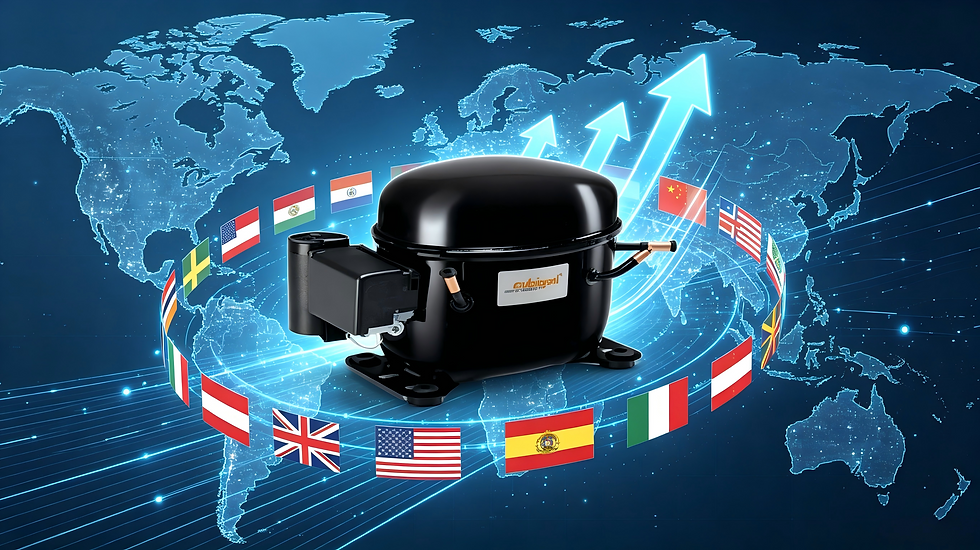
IV. Core Characteristics of the Supply Chain: Technology-Driven Full-Chain Collaborative Ecosystem
In the cooler compressor industry chain, the upstream supply features “localized core materials and internationalized high-end components”: steel is supplied by Baosteel and Angang, aluminum materials rely on Nanshan Aluminum, and leading enterprises have established 45-day safety stocks to cope with aluminum price fluctuations. The mid-to-high-end bearing market is monopolized by Japanese and Swiss enterprises, while Huayi and Meizhi have achieved self-sufficiency in mid-end bearings. Valve components are mainly supplied by Sanhua Intelligent, with Japan’s Saginomiya as a high-end backup. The penetration rate of environmentally friendly refrigerants such as R290 has exceeded 70%, with dedicated production lines from both Meizhi and Huayi.
Midstream manufacturing enterprises each have their technical focuses: Huayi, with its “dual-suction variable frequency” patent, is suitable for supermarket coolers, achieving a defect rate below 0.3% through smart manufacturing; Meizhi focuses on miniaturization and high energy efficiency, with its compressors becoming designated components for 7-Eleven, and its Thailand factory reducing delivery lead times to Southeast Asia to 10 days; Wanbao has broken into the fresh-food e-commerce front warehouse market with its silent technology; Chuqi occupies over 40% of the small and medium-sized cooler factory market in the Pearl River Delta with its high cost performance.
Downstream demand drives precise supply chain adaptation: In the commercial retail sector, Huayi and Meizhi compressors are respectively adapted to Haier coolers and Walmart equipment; in the pharmaceutical cold chain, Huayi’s products have entered Pfizer’s supply chain with significant revenue growth; emerging scenarios such as community group buying and car refrigerators are driving demand for miniaturized compressors (Wanbao) and low-noise compressors (Meizhi). In terms of customer structure, leading enterprises adopt “dual-source procurement”, while regional brands rely on the flexible services of local manufacturers such as Chuqi.
V. Competitive Landscape and Future Trends: From Scale Competition to Value Co-Creation
The current cooler compressor market presents a three-tier competitive landscape. First tier: Huayi, with the world’s leading sales volume in light commercial compressors, invests 5% of annual revenue in R&D, with global annual production capacity exceeding 80 million units; Meizhi holds a 16% global market share, leverages Midea’s R&D network, and its Thailand factory radiates influence across Southeast Asia, dominating the high-end market. Second tier: Wanbao focuses on silent and energy-saving technologies with an annual R&D investment of 150 million yuan and annual production capacity of 36 million units; Chuqi, leveraging the advantages of the Pearl River Delta industrial cluster, specializes in customized small and medium-sized cooler compressors with outstanding regional competitiveness. Third tier: More than 100 small and medium-sized manufacturers survive by imitation, with thin production capacity and profits, facing dual pressures from policies and the market.
In the future, the industry will restructure toward technological upgrading, supply chain strengthening, and business model innovation: the penetration rate of R290 refrigerant will exceed 90%, and the CO₂ compressors under development by Huayi and Meizhi will achieve energy savings of 40%; Meizhi’s IoT compressor fault prediction accuracy will reach 90%, and magnetic bearing technology is expected to be commercialized in 2026. On the supply chain front, leading enterprises are accelerating overseas layouts in Brazil, India, etc., with the Yangtze River Delta and Pearl River Delta forming efficient supporting systems, while strengthening risk management through price linkage mechanisms and component inventory buffers. In terms of business models, Huayi has launched a “compressor + IoT” integrated solution, Meizhi provides full-lifecycle management services, and Wanbao is piloting core component recycling and remanufacturing, achieving a reuse rate of 70%.


Comments