Global Commercial Refrigeration Landscape: Formation & Evolution
- Apr 23
- 5 min read
Phase I: Technological Emergence and Initial Industry Formation (1900–1950)
In the early 20th century, the global refrigeration industry originated from mechanical refrigeration technologies, with development largely driven by the United States and gradually taking shape amid the wave of industrialization. Supported by its strong industrial base, the U.S. was the first to achieve practical application of compressor-based refrigeration systems. Brands such as General Electric (GE) and Frigidaire introduced early refrigerators and beverage coolers.
In 1926, General Electric manufactured the world’s first refrigerator with a fully sealed refrigeration system, followed in 1927 by the first household absorption refrigerator. These products gradually gained widespread adoption during the 1930s, laying the foundational framework for modern commercial cold-chain systems.
In Europe, the diffusion of refrigeration equipment was slower due to the impact of the two World Wars. Nevertheless, countries such as Germany and Sweden began establishing their own refrigeration industries, gradually forming the high-precision manufacturing traditions for which they later became known.
In Asia, only Japan conducted limited refrigeration technology experiments prior to World War II. Other regions of the world relied almost entirely on imports and had not yet developed independent industrial structures.Overall, this phase established an initial global industry pattern characterized by the United States as the technological origin and Europe as a region with strong manufacturing potential.

Kelvinator Product Catalog (circa 1930): A product album from the Kelvinator Company held in the Hagley Museum in the United States, containing sketch illustrations of early electric refrigerators. It serves as valuable material for studying product design of that era.
Phase II: Household Appliance Penetration and Industrial Scaling (1950–1980)
Following the end of World War II and the recovery of the global economy, refrigeration equipment rapidly was widely popularized across Europe and North America, becoming standard fixtures in both household and commercial settings. The adoption of chlorofluorocarbon (CFC) refrigerants significantly improved product safety and reliability, driving sharp increases in production volume.
During this period, the United States emerged as the world’s largest consumption market, with refrigerator penetration rates rising dramatically. Brands such as Whirlpool and General Electric promoted product standardization and mass industrial production.
In Europe, countries including Germany and Italy developed highly reliable manufacturing bases. Brands such as Bosch, Siemens, and Electrolux rose quickly, establishing Europe’s strong reputation for quality and craftsmanship.
In Asia, Japan achieved critical breakthroughs through postwar industrial reconstruction, particularly in compressor technology, miniaturized refrigeration systems, and overall product quality. Brands such as Hoshizaki and Panasonic laid a solid technological foundation. Meanwhile, China began its initial attempts at independent refrigerator production in the 1950s; for example, in 1956, the Tianjin Medical Equipment Factory successfully produced a sealed compressor prototype. Other regions continued to rely primarily on imports, and industrial development remained slow.
By the end of this phase, Europe and North America had become the global centers for refrigerator penetration and industry standard formation, while Asia began to demonstrate early capabilities in technological catch-up.
Phase III: Energy Efficiency Regulation and Global Brand Expansion (1980–2005)
As global environmental concerns intensified, the signing of the Montreal Protocol accelerated the industry’s transition away from CFC refrigerants toward new, environmentally friendly alternatives. Europe and North America took the lead in establishing and enforcing strict energy efficiency regulations, pushing the refrigeration industry into a major technological transition centered on environmental protection and energy efficiency.

During this phase, the United States maintained its dominant market scale and developed a mature commercial refrigeration ecosystem. Professional brands such as True Manufacturing and Hussmann secured leading positions in the foodservice and retail sectors.
Driven by stringent energy and environmental regulations, Europe advanced technologies in high energy efficiency, low power consumption, and environmentally friendly refrigerants. Brands such as Liebherr and Epta further consolidated Europe’s leadership in technical standards.
In Asia, the industry’s role evolved from technology follower to** manufacturing powerhouse**. Manufacturing capacity in China’s coastal regions expanded rapidly; by 1988, China’s annual refrigerator output had surged to 7.55 million units, laying a solid foundation for its emergence as the “ world’s factory.” South Korea’s LG and Samsung entered high-end home appliance manufacturing, while Japan continued to maintain its advantages in precision refrigeration and compressor technologies.

Meanwhile, countries such as Türkiye, Mexico, and Poland became key recipients of manufacturing spillover, while regional brands emerged in Latin America, including Metalfrio Solutions, Mimet, and Refrimate.
During this period, a initial three-pole global industry structure took shape for the first time: Europe and North America as standard setters, Asia as a rapidly expanding manufacturing base, and other regions serving as supplementary manufacturing and consumption markets.
Phase IV: Global Supply Chain Restructuring and the Rise of Asia (2005–2018)
The global center of refrigeration manufacturing gradually shifted toward Asia, with China becoming the world’s largest producer and exporter of refrigeration equipment. Chinese brands such as Haier, Midea, and Hisense entered global markets, driving a fundamental restructuring of industry supply chains.

At the same time, European and North American brands accelerated global expansion through acquisitions, partnerships, and overseas manufacturing to reinforce their market positions. Haier’s acquisition of GE Appliances in 2016 became a landmark case in this process.
The United States continued to maintain high profitability and market control in the commercial refrigeration segment, while Europe preserved technological leadership in energy efficiency and environmentally friendly refrigerants, despite a gradual contraction of domestic manufacturing scale. During this phase, Asia completed a critical transition from being merely a global manufacturing center to becoming a global brand center, capable of addressing demand across the full spectrum from high-end to mid-range products. Japan and South Korea remained firmly positioned in high-end and professional refrigeration niches.
Other regions continued to absorb manufacturing capacity, with countries such as Türkiye and Mexico growing in importance as regional manufacturing hubs.
By this stage, a clear and stable global industry structure had emerged: Asia leading manufacturing, Europe and North America leading brands and standards, and other regions functioning as extensions of both markets and production capacity.
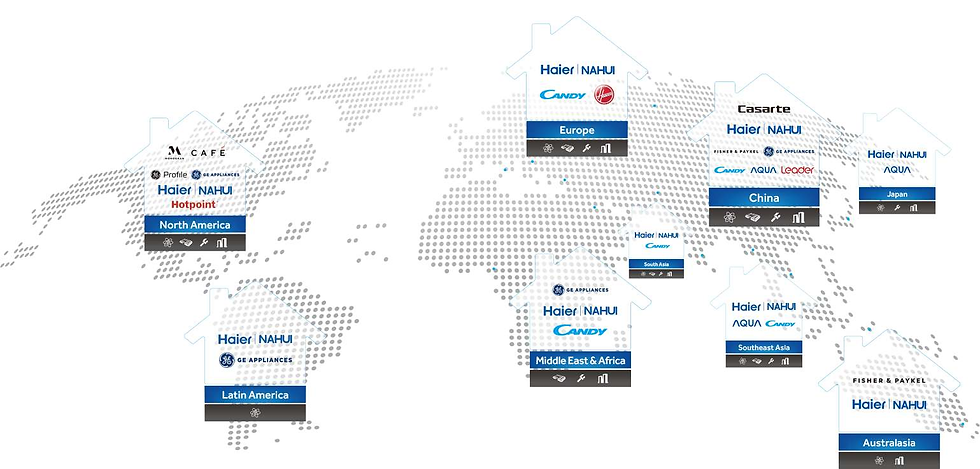
Phase V: The Era of Intelligence, Sustainability, and Carbon Neutrality (2018–Present)
In the current era, the global refrigeration industry has accelerated development along three key dimensions: energy efficiency upgrades, adoption of natural refrigerants, and intelligent technologies. Europe and North America continue to drive industry evolution through stringent regulations. The United States retains its leading position in commercial refrigeration, while Europe leads globally in the application of natural refrigerants such as R290 and R600a, as well as deep energy-saving technologies.
Asia has become both a global manufacturing center and a demand hub. China’s dominance in the global supply chain has further strengthened, alongside breakthroughs in intelligent control systems, Internet of Things (IoT) integration, and energy management technologies. Japan and South Korea continue to lead in professional refrigeration, compressor technology, and high-reliability systems.
Other regions remain high-growth markets, with the Middle East, Africa, and Latin America emerging as key expansion frontiers for global brands.
Under the combined influence of environmental sustainability, intelligent technologies, and large-scale manufacturing, the global refrigeration industry structure has become increasingly stable and deeply entrenched.
Conclusion: The Tri-Polar Structure of the Global Refrigeration Industry
Reviewing the entire development trajectory, the evolution of the global refrigeration industry follows a clear and consistent logic. Europe and North America established themselves early as standard setters and have maintained long-term leadership in energy efficiency, environmental protection, and professional commercial refrigeration. Asia, propelled by globalization of supply chains, rose rapidly to become the largest manufacturing base and the fastest-growing consumption region, while gradually forming a competitive portfolio of international brands. Other regions are primarily positioned as regional consumption markets and recipients of manufacturing spillover, playing complementary and expansionary roles within the global supply chain.
Ultimately, the global refrigeration industry has solidified into a stable tri-polar structure: Europe and North America dominating standards and high-end markets, Asia leading manufacturing and demand growth, and other regions providing extended markets and manufacturing capacity.


Comments